

Over the years, I’ve worked with many people who were convinced that something about their tinnitus made habituation impossible.
Sometimes it was the pitch. A lot of tinnitus patients experience an extremely high-pitched ringing or whistling sound that seems to cut through everything around them.
Other times, it was the volume, the number of different sounds they heard, or the way their tinnitus fluctuated throughout the day.
And inevitably, they would ask me some version of the same question: “I understand that people can habituate to tinnitus. But what if my tinnitus is just too annoying? What if my sound is different?”
Of course, I completely understand their fear. When you’re suffering from bothersome tinnitus, it’s difficult to imagine how something that feels so intrusive, unpleasant, and impossible to ignore could ever stop bothering you.
And to their point, I actually believe that some sounds are naturally more annoying and unpleasant than others.
But just because a sound is inherently more annoying, or more difficult to live with, doesn’t necessarily mean it will be more difficult to habituate.
And how unpleasant your tinnitus feels today doesn’t determine whether your brain can eventually learn to stop being bothered by it.
Some Sounds Really Are More Annoying Than Others
If I were to gather a thousand people and ask them to listen to a wide variety of sounds – like pounding rainfall, a humming refrigerator, a car alarm, a dentist’s drill, nails on a chalk board, and someone scraping a fork across a plate – and then rank those sounds from least annoying to most annoying, I suspect we would find some general agreement.
Certain sounds have characteristics that tend to make them generally more unpleasant to our ears. High-pitched, piercing, repetitive, or unpredictable sounds will likely rank higher than softer, more consistent background noises.
But I also know that we would find some interesting individual differences.
In my work with sound sensitive clients, I’ve created a massive, categorized library of difficult noises that can be used in various sound desensitization exercises. All of the soundscapes are YouTube videos, and I always joke with my clients that whatever sound they find most triggering, someone else loves that sound so much, they created an 8-hour version and uploaded it so others like them can sleep with it at night.
At the individual level, there are often big differences in the kinds of sounds people find difficult. And this is something I’ve seen repeatedly in my tinnitus coaching practice.
On many occasions, I’ve worked with multiple people who experience remarkably similar tinnitus sounds but have completely different reactions.
For example, consider two people who both experience a high-pitched ringing sound and a lower-pitched humming or thumping sound.
The first person describes the high-pitched ringing as if someone was drilling through their brain. They can’t imagine how anyone could ever habituate to something so piercing and intrusive.
Meanwhile, the lower-pitched sound barely bothers them at all. It’s easily masked by the world around them and doesn’t get in the way.
But the second person feels exactly the opposite.
To them, the high-pitched ringing is just the familiar kind of tinnitus they’ve always experienced after loud concerts. It’s annoying sometimes, but they don’t find it particularly threatening.
The lower-frequency sound, however, feels like a bass thumping through everything around them. They can’t imagine how anyone could possibly get used to it.
I’ve heard so many variations like this from clients over the years.
Both people are convinced that the sound they find most distressing is inherently more difficult to live with. But each person has a completely different relationship with essentially the same two sounds.

So what’s actually going on here?
The bottom line is that the characteristics of a sound matter, but they aren’t the only factors that contribute to how unpleasant that sound feels.
Our personal experiences, associations, emotional responses, and the meaning we assign to a sound can dramatically influence how we experience it.
And when it comes to tinnitus, that distinction becomes especially important.
When Almost Any Sound Can Become Unbearable
One thing I’ve learned from working with so many people struggling with bothersome tinnitus is that the experience of unpleasantness has a lot to do with what happens when someone starts to get caught in the cycle of fear, anxiety, and hypervigilance, and not just what the noise itself sounds like.
When tinnitus first becomes frightening, the brain often begins to treat it as something threatening.
Attention becomes increasingly focused on the sound. You start monitoring it throughout the day, noticing every fluctuation, and wondering what those changes might mean.
As your nervous system becomes more activated, your tinnitus can begin to feel more intrusive, louder, and much more difficult to tolerate.
And the more distressing the experience becomes, the more convinced you may feel that something about your particular sound must be responsible.
After all, if your tinnitus weren’t so terrible, why would you be suffering this much?
But the intensity of your suffering is not simply a consequence of what your tinnitus sounds like. And it certainly doesn’t tell us everything about your ability to habituate.
I’ve worked with countless people whose tinnitus was extremely high-pitched, piercing, or otherwise unpleasant, who eventually habituated and reached a point where the sound no longer meaningfully interfered with their lives.
And it was not because they suddenly decided the sound was pleasant, or they started to like it somehow. And it was also not necessarily because the tinnitus itself became quieter.
It was because their relationship with the sound changed.
The tinnitus gradually stopped demanding the same level of attention and triggering the same emotional and physiological response, until life went back to normal.
The sound was still there, but it no longer had any significance, and so it faded from conscious awareness.
What About the Volume of Your Tinnitus?
Another fear I hear very often is that someone’s tinnitus is just too loud to habituate to.
And again, I completely understand why this feels convincing. Generally speaking, the experience of tinnitus increasing in volume is one of increasing distress.
When tinnitus seems extraordinarily loud, it’s difficult to imagine ever reaching a point where it doesn’t dominate your awareness.
But tinnitus volume doesn’t tell us the whole story.
How loud tinnitus seems and how much distress it causes are not the same thing.
Perceived tinnitus loudness can be influenced by many factors, including the sound of our surrounding environment, where our attention is focused, and our level of emotional and physiological arousal.
Now to be clear, this doesn’t mean that changes in tinnitus volume are always psychological. Tinnitus volume can fluctuate, and people can experience very different levels of perceived loudness.
But when our nervous system is highly activated, and we’re anxious, hypervigilant, and constantly monitoring our tinnitus, the sound can become much more prominent in our awareness, increasing significantly in perceived loudness and intensity. This is especially true during periods of sleep deprivation, or times of intense stress.
On the other hand, sometimes volume doesn’t tell us anything at all. In some cases, the difference between the volume of a sound and the level of suffering can be astonishing.
I remember working with a client several years ago who was experiencing some of the most severe tinnitus-related distress I had ever encountered.
He struggled with significant anxiety, perfectionism, and obsessive-compulsive tendencies. His tinnitus had become the central focus of his life, and he was suffering enormously.
And yet, his tinnitus volume was surprisingly low. In fact, he told me that whenever the fan on his laptop turned on, he couldn’t hear his tinnitus anymore.
Here was someone whose tinnitus was drowned out by so many environmental noises, yet the distress he experienced was among the most intense I’d seen in my coaching practice.
Importantly, he eventually fully habituated and has remained habituated for years now.
But I think about him often because his experience illustrates something that can be difficult to understand when you’re struggling: The intensity of someone’s tinnitus-related suffering isn’t necessarily proportional – or even related – to the volume of the sound.
His distress was absolutely real. But the volume of his tinnitus alone could not explain why he was suffering so much.
And the intensity of that suffering ultimately did not determine what his future would look like.
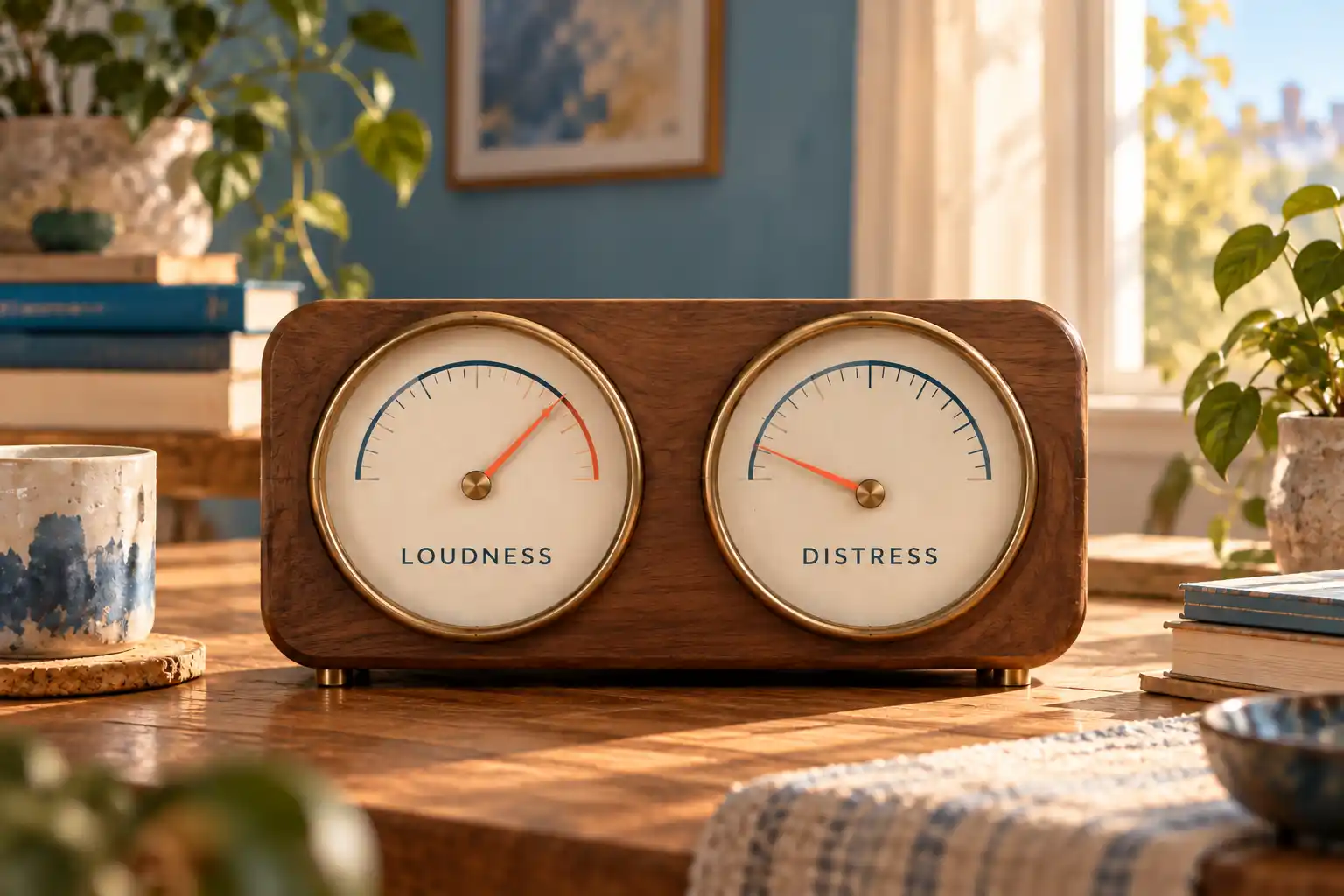
Now remember, I’m not suggesting that volume is irrelevant. Someone with very loud tinnitus will likely have a very different experience.
But I am suggesting that the volume of tinnitus alone does not determine whether habituation is possible.
Because I’ve seen the opposite experience, too. I’ve worked with people who experienced very loud tinnitus, where they could hear it over most or all of the sounds in their environment, but who nevertheless went on to habituate.
And there’s something else important to understand here. The way you experience the volume of your tinnitus can change dramatically as you habituate. In fact, I’ve seen this happen repeatedly with my clients. As their anxiety and hypervigilance decreased, their tinnitus often began to seem quieter and less intrusive, even when they could still hear it clearly.
This doesn’t necessarily mean the tinnitus signal itself became quieter. But the experience of loudness can change as your brain gradually stops treating the sound as something important that demands your attention.
A louder sound may be more noticeable. But being able to hear your tinnitus and being bothered by your tinnitus are two very different things.
Different Tinnitus Sounds Can Present Different Challenges
I truly do not believe that any particular type of tinnitus sound is inherently impossible to habituate to, though I fully acknowledge that different tinnitus experiences can present different challenges.
For example, some sounds are harder to mask or blend with environmental sound.
Very high-pitched tinnitus, particularly at frequencies above what we typically encounter in everyday environments, can remain much more noticeable even when there’s plenty of background noise.
Other people experience multiple tinnitus sounds, each with its own pitch, quality, or pattern, requiring habituation.
Some people experience tinnitus that fluctuates significantly throughout the day, comes and goes intermittently, or changes in response to external sounds. And these experiences can introduce additional complications.
When tinnitus is relatively consistent, there may be more opportunities to become familiar with its usual pattern.
But when the sound changes frequently, each fluctuation can capture your attention again.
And if you’ve developed a fear of those changes, you may find yourself constantly anticipating the next spike or monitoring how your tinnitus responds to different environments.
For people who also experience significant sound sensitivity, everyday activities may present additional challenges because certain sounds can be uncomfortable or difficult to tolerate.
I don’t want to minimize any of these difficulties. These are real differences, and they influence the strategies necessary for recovery, as well as how you approach the habituation process. But having additional challenges doesn’t mean habituation is impossible either. You have not somehow reached the limit of what is possible for your brain.
I’ve worked with many people experiencing multiple tinnitus sounds, significant fluctuations, reactivity, and sound sensitivity who made incredible progress and were able to habituate.
I’ve also worked with countless people who initially felt completely overwhelmed by these experiences, and were convinced they were the exception, until they eventually reached a point where tinnitus no longer dominated their lives.
Sometimes the process requires more time, additional strategies, or a different approach. But having a more complicated tinnitus experience doesn’t mean habituation is out of reach.
And these differences do not give us any kind of special knowledge about what is going to happen next, or where this is all going.
Habituation Doesn’t Require You to Like Your Tinnitus
One of the biggest misconceptions about habituation is that it somehow requires the sound to change in some way, or become less annoying.
You never need to like the sound of your tinnitus or convince yourself that it isn’t actually unpleasant.
Imagine you move into an apartment near a busy intersection in a densely populated city.
At first, the traffic noise will likely be incredibly irritating. You will notice every passing car, every truck, ambulance siren, and every sudden burst of noise. You’ll probably wonder how anyone could possibly live with so much background sound.
But over time, something changes. The traffic noise doesn’t become quieter, or more predictable. You won’t suddenly feel like you enjoy listening to traffic, and you probably will still find it unpleasant.
But you no longer notice it as often. You’ll find that you can read, work, relax, and go about your life without constantly thinking about the road outside. And when you do notice the traffic, it won’t necessarily bother you like before.
Because your brain has learned that the traffic noise is not important and doesn’t require constant attention.

Tinnitus is obviously different from external environmental noise. You can get away from the traffic sounds when you want to.
But it’s still a helpful comparison. If your brain can filter the unpredictable, unpleasant noises of the city, tinnitus that fluctuates and changes is not out of reach of habituation. And more importantly, you don’t have to find a sound pleasant for your brain to learn that it isn’t important.
Habituation is about gradually changing the significance the sound holds in your life.
As the fear and emotional responses surrounding tinnitus start to lessen, the sound can start to become less intrusive. You may notice it less frequently.
And when you do notice it, you may find that it doesn’t bother you nearly as much as it once did.
Eventually, tinnitus can become something you notice without feeling compelled to do anything about it. You just get back to your day, because nothing actually happened.
And the tinnitus itself does not need to change or go away for that to happen.
Your Tinnitus Doesn’t Have to Be Easy
If there’s one thing I hope you take away from this article, it’s this: You don’t have to convince yourself that your tinnitus sounds aren’t annoying or bothersome.
Maybe your tinnitus is extremely high-pitched. Maybe it’s loud, fluctuating, reactive, or made up of several different sounds.
Maybe you believe that most people would find your particular tinnitus extraordinarily unpleasant, and that might actually be true.
And certain aspects of your experience may in fact present additional challenges that need to be addressed.
But none of this establishes that habituation is impossible.
Over the years, I’ve worked with people experiencing an enormous variety of tinnitus sounds, including sounds that they initially believed no one could ever learn to live with.
And I’ve watched them make extraordinary progress as the way they experienced it changed.
I can’t tell you exactly how your tinnitus will change over time, or what your individual recovery process will look like.
But I can tell you that how unpleasant your tinnitus feels today doesn’t determine the limits of what’s possible tomorrow.
You don’t have to believe your tinnitus is easy. You don’t have to compare your sound to someone else’s. And you don’t have to prove that your tinnitus is less severe than you think it is.
You just have to recognize that even the most difficult tinnitus experiences can change, and that habituation may be possible in ways you can’t yet imagine.
No matter how difficult your tinnitus feels today, it doesn’t have to feel this way forever.

